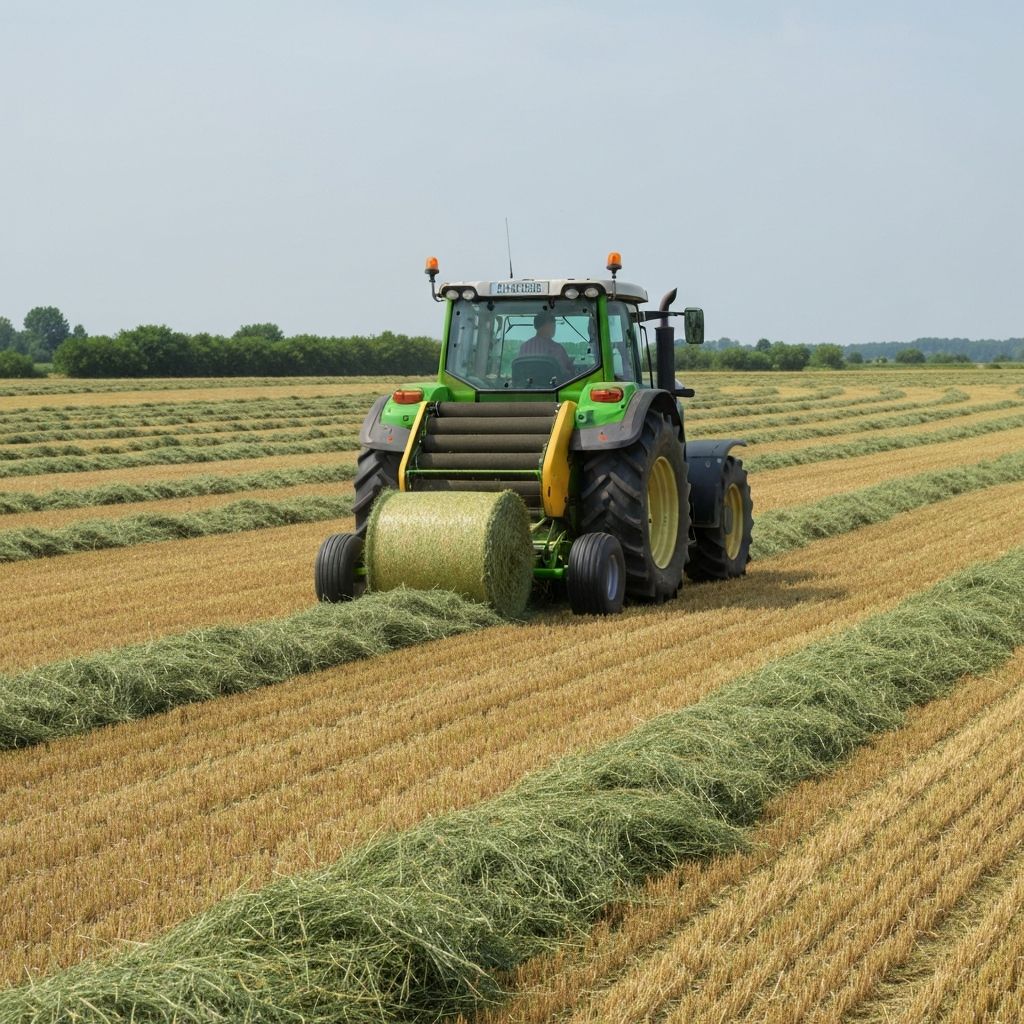
Best Tractors for Hay (2026)
Updated Feb 5, 2026
Compare 20+ hay-ready tractors by PTO horsepower, baler compatibility, and field performance. Expert coverage of mowing, baling, tedding, and hay hauling requirements.
What Makes a Good Hay Tractor
Hay work demands specific tractor capabilities that differ from loader or mowing tasks. The baler is the limiting factor—your tractor must deliver adequate PTO horsepower, have proper hydraulic capacity, and provide enough weight and traction for field conditions. Many tractors fail at hay work despite having "enough HP" on paper because they lack PTO power or stability.
PTO HP vs Engine HP
Engine HP is measured at the flywheel; PTO HP is what's actually available to drive your baler—typically 15-20% less. Baler manufacturers specify PTO HP requirements, not engine HP. A "50 HP" tractor may only have 40-42 PTO HP. Always check PTO specs when matching equipment.
Baler Compatibility
Your baler determines minimum tractor size. Small square balers need 25-35 PTO HP, 4x5 round balers need 45-55 PTO HP, and large square balers need 90-150 PTO HP. Undersized tractors bog down, damage clutches, and make inconsistent bales. Size for your heaviest implement.
Hydraulic Remotes
Hay equipment requires hydraulic power for implement lift and functions. Basic operations need 2 remotes; mower-conditioners with header tilt need 3; large square balers may need 4+. Factory-installed remotes are preferred—aftermarket additions are expensive.
Tractor Weight and Traction
Heavy balers create tongue weight that can lift the front end. Your tractor should weigh at least 3x your expected bale weight for stability. A 5,000 lb tractor handles 1,500 lb bales; heavier bales need heavier tractors or additional ballast.
4WD for Field Work
While 2WD works on flat, dry fields, 4WD is strongly recommended for hay work. Baling often occurs when fields may be soft from recent rain, and pulling heavy equipment up hills requires traction. The cost premium is minimal compared to capability gained.
Transmission Options
Power shuttle transmissions are popular for hay—easy direction changes for field turns without clutching. Hydrostatic allows precise speed control for bale density. Gear transmissions are efficient for transport. CVT offers the best of both worlds but at premium cost.
PTO Horsepower Requirements by Equipment
Match your tractor's PTO HP to your hay equipment. Using the recommended (not minimum) PTO HP provides headroom for hills, heavy crops, and extended equipment life. These requirements assume dry hay conditions.
| Equipment Type | Min PTO HP | Recommended PTO HP | Notes |
|---|---|---|---|
| Small Square (14x18) | 25 HP | 35 HP | Light PTO load, entry-level tractors work well |
| 4x4 Round Baler | 35 HP | 45 HP | Compact tractors can handle with adequate PTO |
| 4x5 Round Baler | 45 HP | 55 HP | Most common size, needs mid-range utility tractor |
| 5x5 Round Baler | 55 HP | 70 HP | Heavy bales, requires good traction |
| 5x6 Round Baler | 65 HP | 85 HP | Large bales, utility tractor minimum |
| Large Square (3x3) | 90 HP | 120 HP | Commercial operations only |
| Large Square (3x4) | 110 HP | 150 HP | High-capacity commercial balers |
| 7 ft Disc Mower | 25 HP | 35 HP | Compact tractors suitable |
| 9 ft Disc Mower | 35 HP | 50 HP | Mid-range utility tractor |
| 11+ ft Disc Mower | 50 HP | 75 HP | Larger utility tractor required |
| Tedder (4 basket) | 20 HP | 30 HP | Light PTO requirement |
| Rake (wheel type) | 20 HP | 30 HP | Ground-driven, minimal PTO |
Hay Tractor Recommendation Calculator
Answer a few questions about your hay operation and get personalized tractor recommendations with calculated PTO HP requirements, weight targets, and best-fit models.
Your Requirements
Your Results
Fill in your requirements and click "Calculate" to see personalized recommendations.
How This Calculator Works
- PTO HP is calculated based on your baler type and terrain—the primary factors in hay tractor selection
- Tractor weight and traction requirements are matched to bale handling needs and field conditions
- Only tractors that safely meet your PTO HP, weight, and hydraulic requirements are recommended
- Results can be downloaded for free and taken to a dealer—includes compatibility checklist
You can download your personalized results free — no signup required.
Hay Tractor Comparison Table
Compare 20 hay-ready tractors side by side. Click column headers to sort.
| Model | Engine HP | PTO HP | Weight | Remotes | Max Baler | Max Mower | Trans. | Best For |
|---|---|---|---|---|---|---|---|---|
| Fendt 516 Vario | 165 | 140 | 13,200 | 5 | Large Square | 18 ft | Vario CVT | Premium commercial hay |
| Case IH Maxxum 125 | 125 | 107 | 10,500 | 4 | 5x6 Round / Large Square | 16 ft | ActiveDrive 8 | Large commercial hay |
| New Holland T5.120 | 117 | 99 | 8,900 | 4 | 5x6 Round / Large Square | 15 ft | Electro Command | Heavy hay production |
| Kubota M6-111 | 114 | 97 | 9,200 | 4 | 5x6 Round / Large Square | 15 ft | PowerShift | Large-scale hay production |
| Massey Ferguson 5711 | 110 | 94 | 8,600 | 3 | 5x6 Round / Large Square | 14 ft | Dyna-4 | Commercial hay/cattle operations |
| John Deere 6110M | 110 | 92 | 9,500 | 4 | 5x6 Round / Large Square | 15 ft | AutoQuad | Commercial hay operations |
| Kubota M5-091 | 95 | 81 | 7,700 | 3 | 5x6 Round | 13 ft | Hydraulic Shuttle | Mid-size to heavy hay |
| Mahindra 8100 | 83 | 70 | 6,800 | 3 | 5x5 Round | 12 ft | Power Shuttle | Mid-range hay operations |
| Massey Ferguson 4707 | 75 | 64 | 5,800 | 2 | 4x5 Round | 11 ft | Shuttle | Budget hay tractor |
| John Deere 5075E | 75 | 63 | 6,100 | 3 | 5x6 Round | 12 ft | PowrReverser | Heavy hay production |
| New Holland T4.75 | 75 | 63 | 5,500 | 2 | 4x5 Round | 11 ft | Shuttle | Entry-level hay tractor |
| Mahindra 6075 | 75 | 63 | 5,700 | 2 | 4x5 Round | 10 ft | Shuttle | Budget-friendly hay work |
| Case IH Farmall 75C | 75 | 63 | 5,600 | 2 | 4x5 Round | 11 ft | Shuttle | All-around hay tractor |
| New Holland Workmaster 75 | 75 | 62 | 5,200 | 2 | 4x5 Round | 10 ft | Shuttle | Value hay tractor |
| LS MT5.73 | 73 | 61 | 5,400 | 2 | 4x5 Round | 10 ft | Power Shuttle | Value hay operations |
| Kubota M7060 | 71 | 59 | 5,900 | 3 | 4x5 Round | 11 ft | Hydraulic Shuttle | Versatile hay tractor |
| John Deere 5055E | 55 | 46 | 5,200 | 2 | 4x5 Round | 10 ft | SyncShuttle | Mid-size hay farms |
| Kioti DK5310 | 53 | 44 | 4,200 | 2 | 4x4 Round | 9 ft | Shuttle | Small hay operations |
| John Deere 5045E | 45 | 38 | 4,850 | 2 | 4x5 Round | 9 ft | SyncShuttle | Small hay operations |
| Kubota L3302 | 33 | 27 | 3,200 | 1 | 4x4 Round | 7 ft | Gear | Small acreage mowing |
Picks by Use Case
Best Tractors for Small Hay Operations (Under 50 PTO HP)
For small acreage hay, occasional baling, and mowing-focused operations with small square or 4x4 round balers.
John Deere 5045E
John Deere 5055E
Kubota L3302
Kioti DK5310
Best Tractors for Mid-Size Hay (50-80 PTO HP)
The sweet spot for most hay operations. Handles 4x5 round balers, 9-11 ft mowers, and has headroom for hills.
John Deere 5075E
Kubota M7060
Massey Ferguson 4707
New Holland T4.75
New Holland Workmaster 75
Mahindra 6075
Mahindra 8100
Case IH Farmall 75C
LS MT5.73
Best Tractors for Heavy Hay Production (80+ PTO HP)
For commercial hay operations, large square balers, and high-volume production.
John Deere 6110M
Kubota M5-091
Kubota M6-111
Massey Ferguson 5711
New Holland T5.120
Case IH Maxxum 125
Fendt 516 Vario
Best Budget Hay Tractors
Value-focused brands offering adequate PTO HP at competitive prices for hay work.
Mahindra 6075
Mahindra 8100
Kioti DK5310
LS MT5.73
Best Premium Hay Tractors
Top-tier machines with excellent dealer support, advanced transmissions, and long-term reliability.
John Deere 5045E
John Deere 5055E
John Deere 5075E
John Deere 6110M
Kubota M5-091
Kubota M6-111
Fendt 516 Vario
Hay Field Safety and Best Practices
PTO Safety (Critical)
- Never approach a running PTO—entanglement is the #1 cause of hay-related injuries
- Always disengage PTO and turn off tractor before leaving the seat
- Keep all PTO shields in place—never operate without them
- Wear close-fitting clothing—loose items can catch and pull you in
Hill Baling Tips
- Add 25-30% more PTO HP headroom for hilly terrain
- Keep heavy end (baler) uphill when possible for stability
- Avoid turning on steep slopes—use gradual curves
- Add ballast for improved downhill braking and stability
Fire Prevention
- Check exhaust areas for hay debris buildup—a primary fire source
- Carry a fire extinguisher on the tractor during dry conditions
- Monitor for hot spots after stopping—check bearings and belts
- Clean radiator screens regularly to prevent overheating
Baler Best Practices
- Maintain consistent ground speed for uniform bale density
- Don't overstuff bales—creates dangerous tension and equipment damage
- Check hay moisture before baling (ideally 15-18% for dry hay)
- Grease baler daily and check belts/bearings regularly
Round Bale Transport Warning
Round bales can roll unexpectedly. Never stand behind a bale being unloaded. Secure bales on wagons/trailers with proper restraints. When stacking, ensure stable pyramid patterns.
Frequently Asked Questions
How much PTO HP do I need for hay baling?
PTO HP requirements depend on your baler size. Small square balers need 25-35 PTO HP, 4x4 round balers need 35-45 PTO HP, 4x5 round balers need 45-55 PTO HP, 5x6 round balers need 65-85 PTO HP, and large square balers need 90-150 PTO HP. Always check your baler manufacturer's minimum PTO requirement and add 15-20% margin for hills and heavy crop conditions.
Can compact tractors handle hay work?
Compact tractors (25-45 HP) can handle limited hay work including small square baling, 4x4 round baling, and mowing up to 9 ft widths. However, they lack the PTO HP and weight for larger balers. If you're making more than 50-100 bales per season or running a 4x5+ round baler, a utility tractor (50+ HP) is the better choice for productivity and longevity.
Do I need 4WD for hay work?
4WD is highly recommended for hay work. While mowing and raking on flat, dry fields works fine with 2WD, baling often occurs when fields may be soft from recent rain, and hauling loaded wagons up hills requires traction. 4WD also provides better control when turning with heavy implements. The cost difference is minimal compared to capability gained.
What tractor size is best for round bales?
For standard 4x5 round bales (800-1,200 lbs), you need a utility tractor with at least 45 PTO HP and 4,500+ lbs operating weight. For 5x6 round bales (1,500-2,000 lbs), you need 65+ PTO HP and 6,000+ lbs. The tractor must have enough weight and traction to pull the baler and handle the bale, especially on hills.
How many hydraulic remotes are required for hay work?
Most basic hay operations need 2 hydraulic remotes: one for mower/rake lift and one for baler functions. If you're running a combination of implements (like a mower-conditioner with header tilt) or need to operate a bale accumulator, 3 remotes is better. Large square balers and sophisticated equipment may require 4+ remotes.
What transmission is best for baling hay?
Hydrostatic transmissions allow precise speed control without clutching, which is valuable for maintaining consistent bale density. However, gear or shuttle transmissions are more efficient for long-distance field work and transport. Many hay operators prefer power shuttle transmissions as a middle ground—easy directional changes without full hydrostatic complexity.
Why does my tractor struggle with my baler on hills?
Baling on hills requires more PTO HP than flat ground—up to 30% more for steep slopes. If your tractor bogs down, you likely don't have enough PTO HP reserve or tractor weight. Solutions include: using a smaller baler, making lighter bales, adding ballast, or upgrading to a more powerful tractor. Never push a marginal tractor/baler combo on hills.
What's the difference between PTO HP and engine HP for hay?
Engine HP (gross) is measured at the flywheel. PTO HP (net) is what's actually available at the power take-off after drivetrain losses—typically 15-20% less than engine HP. Baler manufacturers specify PTO HP requirements because that's what drives the implement. Always compare PTO HP specs when matching tractors to hay equipment.
Can I use the same tractor for mowing, tedding, raking, and baling?
Yes, but size your tractor to your most demanding task—usually baling. A 70 PTO HP tractor handles most hay operations: 9-11 ft mowers, tedders, rakes, and 4x5 round balers. If you're running a large square baler, you'll need 90+ PTO HP. Having one properly-sized tractor is more efficient than juggling multiple undersized units.
Is tractor weight important for hay work?
Yes, tractor weight affects traction, stability, and baler performance. Heavy balers create tongue weight that can lift the front end, reducing steering control. For round baling, your tractor should weigh at least 3x your expected bale weight. A 5,000 lb tractor handles 1,500 lb bales; 1,800 lb bales need 6,000+ lb tractors. Add ballast if needed.
Related Guides
Lift capacity, ballast, and loader recommendations
Mowing GuideFinish mowing and brush hogging recommendations
Find Dealers Near YouLocate authorized dealers in your area
Snow Removal GuideOff-season use for your hay tractor
Browse Utility TractorsCompare all utility models for hay work
All Task-Based GuidesLoader, mowing, snow, and more
This guide is maintained by the Tractor Iron editorial team using manufacturer specifications, dealer input, and real-world owner feedback. Specifications are verified against official sources and updated regularly. Last updated: February 5, 2026.