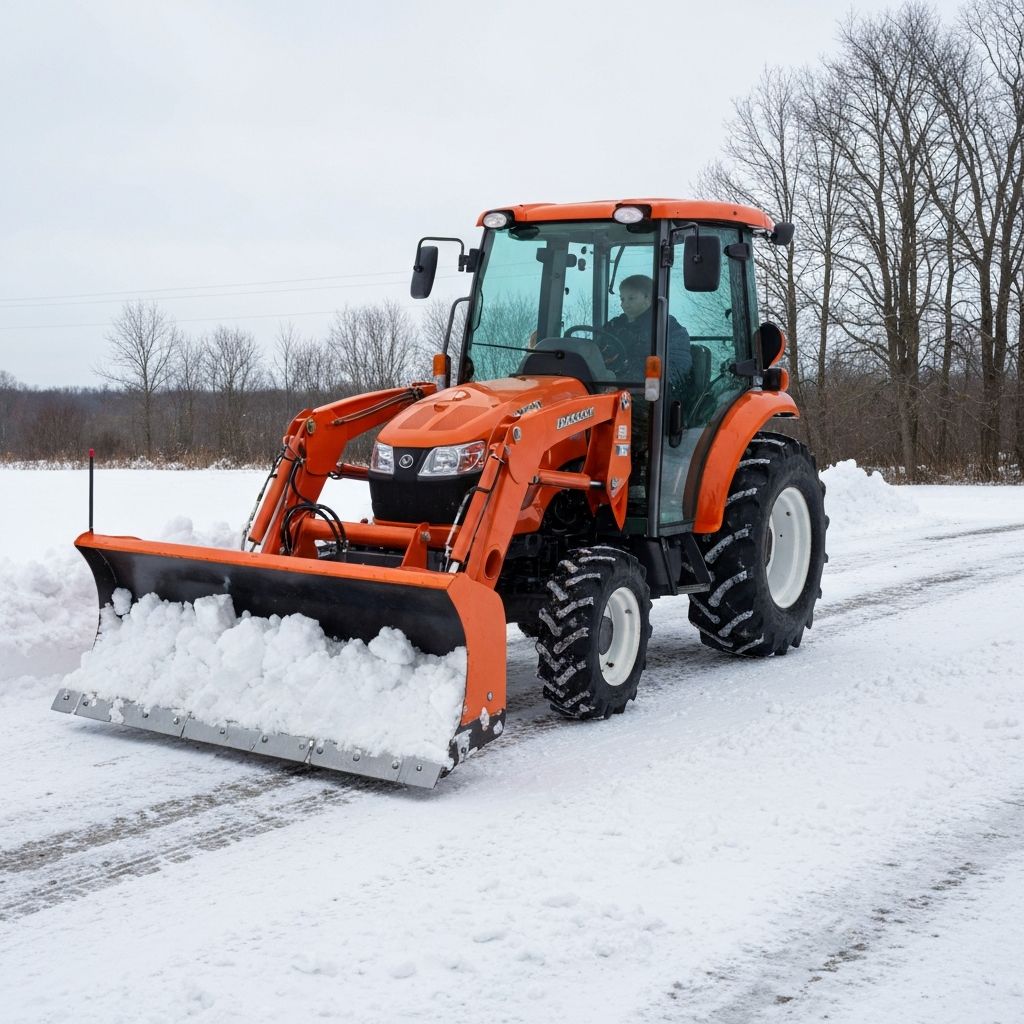
Best Tractors for Snow Removal (2026)
Updated Feb 5, 2026
Compare 20 winter-ready tractors. Expert coverage of snow blowers vs blades, PTO HP requirements, traction systems, and cold-weather features for driveways, farm lanes, and commercial snow removal.
What Makes a Good Snow Removal Tractor
Snow removal demands more than just horsepower. You need adequate PTO HP for blowers, enough weight for traction, cold-weather reliability, and the right attachment setup. A good snow tractor works reliably in freezing temps, maintains traction on ice, and clears snow efficiently without excessive tire spin.
PTO HP vs Engine HP
Snow blowers are powered by the PTO, not the engine. PTO HP is typically 80-85% of engine HP. A 40 HP engine provides about 32-34 PTO HP. Always check PTO HP ratings when sizing snow blowers— engine HP alone can be misleading.
Blade vs Snow Blower
Blades are faster for light snow on pavement—you can plow at 5-8 MPH. Snow blowers handle any depth, work on gravel without surface damage, and throw snow farther. Heavy/wet snow almost always requires a blower. Many operators use both.
Traction and Weight
Heavier tractors maintain better traction on snow and ice. 4WD is essential—it provides steering control and forward traction. Chains add 30-50% more grip on ice. Even with 4WD and chains, steep slopes on ice can defeat traction.
Hydrostatic for Snow Work
Hydrostatic transmission is strongly preferred for snow removal. It allows seamless forward/reverse without clutching—essential when repeatedly backing up and pushing. Cold weather thickens hydraulic fluid, so let the tractor warm up before heavy operation.
Cold-Weather Features
Block heaters prevent hard starts in extreme cold. Heated cabs keep the operator comfortable. Winter-grade hydraulic fluid maintains responsiveness. Battery maintainers keep starting power strong. These features make the difference between reliable winter work and frustration.
Attachment Sizing
Match blower width to PTO HP: roughly 1 HP per inch of width for powder, 1.5 HP for wet snow. Never exceed the tractor's tire track width with a blower—it creates stability issues. Blades can be wider but need adequate weight for downpressure.
Snow Attachment PTO Requirements
Use this table to match your attachment size to your tractor's PTO HP. Underpowered blowers clog and stall in heavy snow. Blades don't need PTO power but require adequate weight for downpressure.
| Attachment | Minimum HP | Recommended HP | Notes |
|---|---|---|---|
| 42-48" Snow Blower | 18-22 PTO HP | 25-30 PTO HP | Sub-compact tractor minimum; light/powder snow only at min HP |
| 54-60" Snow Blower | 25-30 PTO HP | 35-45 PTO HP | Most common residential size; needs more HP for wet snow |
| 66-72" Snow Blower | 35-45 PTO HP | 50-60 PTO HP | Heavy-duty residential/light commercial; significant traction needed |
| 78-84" Snow Blower | 50-60 PTO HP | 65-80 PTO HP | Commercial grade; requires utility-class tractor |
| 48-60" Front Blade | N/A | 20-30 Engine HP | PTO not required; weight and traction more important than HP |
| 66-78" Front Blade | N/A | 30-45 Engine HP | Heavier blade needs more weight for downpressure; 4WD essential |
| 72-96" Rear Blade | N/A | 35-55 Engine HP | Rear blades require front ballast; used for grading/backdrag |
| Loader + Pusher Box | N/A | 30-50 Engine HP | Fastest for parking areas; weight and hydraulics matter most |
Snow Removal Tractor Recommendation Calculator
Answer a few questions about your snow removal needs and get personalized tractor recommendations with calculated PTO HP requirements, traction needs, and best-fit models for your winter conditions.
Your Winter Requirements
Your Results
Fill in your winter requirements and click "Calculate" to see personalized recommendations.
Snow-Ready Tractor Comparison Table
Compare 20 winter-capable tractors side by side. Click column headers to sort.
| Model | Engine HP | PTO HP | Weight | Max Blower | Max Blade | Winter Score | Cab | Trans. | Best For |
|---|---|---|---|---|---|---|---|---|---|
| New Holland T4.75 | 75 | 62.5 | 5,890 | 92" | 132" | 97 | Yes | Gear/Hydro | Heavy-duty winter operations |
| Mahindra 6065 | 65 | 53.2 | 5,291 | 84" | 120" | 91 | Yes | Gear/Hydro | Large property/commercial |
| Kubota M6060 | 64 | 52.8 | 5,512 | 84" | 120" | 96 | Yes | Gear/Hydro | Premium utility snow work |
| Kubota MX5400 | 55.5 | 46.3 | 4,409 | 78" | 108" | 95 | Yes | Hydrostatic | Heavy commercial snow |
| Case IH Farmall 55C | 55 | 45.5 | 4,523 | 78" | 108" | 89 | Yes | Gear/Hydro | Versatile winter utility |
| John Deere 5055E | 55 | 45.2 | 4,630 | 78" | 108" | 93 | Yes | Gear/Hydro | Municipal/commercial use |
| Kubota L4701 | 47.3 | 39.5 | 3,902 | 72" | 96" | 92 | Yes | Hydrostatic | Commercial snow clearing |
| John Deere 4044M | 43.1 | 35.6 | 4,012 | 72" | 96" | 94 | Yes | Hydrostatic | Premium winter machine |
| Kubota L3901 | 37.5 | 30.8 | 3,197 | 66" | 84" | 90 | Yes | Hydrostatic | Heavy-duty snow clearing |
| John Deere 3038E | 37.3 | 30.2 | 3,086 | 66" | 78" | 88 | Yes | Hydrostatic | Long driveways, heavy snow |
| Mahindra 2638 | 37.4 | 29.8 | 3,450 | 66" | 84" | 85 | Yes | Hydrostatic | Heavy tractor for traction |
| Kioti CK3510SE | 35 | 27.5 | 3,064 | 64" | 78" | 82 | Yes | Hydrostatic | Value winter package |
| LS MT235E | 34.8 | 27.2 | 2,890 | 64" | 78" | 74 | Yes | Hydrostatic | Budget compact winter |
| Mahindra 1626 | 26.2 | 20.8 | 2,756 | 60" | 72" | 76 | Yes | Hydrostatic | Budget winter tractor |
| Kubota L2501 | 24.8 | 19.5 | 2,535 | 60" | 72" | 82 | Yes | Hydrostatic | Medium driveways, moderate snow |
| New Holland Workmaster 25 | 24.7 | 19.4 | 2,380 | 60" | 72" | 79 | Yes | Hydrostatic | Reliable winter work |
| John Deere 3025E | 24.7 | 19.2 | 2,425 | 60" | 72" | 80 | Yes | Hydrostatic | All-around winter work |
| Yanmar SA424 | 24 | 18.8 | 2,312 | 60" | 72" | 77 | Yes | Hydrostatic | Precise winter work |
| John Deere 1025R | 23.9 | 18.2 | 1,516 | 54" | 60" | 78 | Yes | Hydrostatic | Residential snow removal |
| Kubota BX2380 | 21.6 | 16.6 | 1,477 | 50" | 54" | 72 | No | Hydrostatic | Short driveways, light snow |
Picks by Winter Use Case
Best Tractors for Light Snow (Under 25 PTO HP)
For short driveways, light snowfall regions, and blade-only use. Adequate for residential use in areas with typically light snow.
Kubota L2501
New Holland Workmaster 25
Best Tractors for Medium Snow (25-40 PTO HP)
The sweet spot for most residential users. Handles 54-66" blowers, moderate snow depths, and longer driveways.
John Deere 3038E
Best Tractors for Heavy Snow (40+ PTO HP)
For commercial operations, long farm lanes, heavy/wet snow, and large blowers (66"+). Built for demanding winter conditions.
John Deere 5055E
New Holland T4.75
Case IH Farmall 55C
Best Budget Snow Tractors
Value-focused brands offering good winter capability at competitive prices.
Best Premium Snow Tractors
Top-tier machines with excellent cold-weather reliability, dealer support, and winter feature packages.
John Deere 5055E
Winter Safety and Traction
Traction and Chains
- 4WD is essential for snow work—provides steering control and forward traction
- R4 industrial tires offer the best balance of traction and pavement protection
- Chains add 30-50% more traction on ice and packed snow
- Verify chain clearance before first use—rubbing damages lines and components
Cold Start Best Practices
- Block heater: Plug in overnight when temps drop below 20°F
- Battery: Keep fully charged; cold reduces capacity by 50% at 0°F
- Warm-up: Let engine and hydraulics warm 5-10 minutes before heavy use
- Diesel fuel: Use winter-blend or add anti-gel treatment
Snow Blower Safety
- Throw direction: Always aim away from buildings, cars, and people
- Wind awareness: Wind can redirect snow back at you or onto cleared areas
- Hidden obstacles: Mark obstacles before snow season; ice chunks can damage property
- Clogs: Never clear a clog with hands near the auger; shut down PTO first
Slope Warning
Even with 4WD and chains, icy slopes can defeat traction. Work up/down slopes, not across. Avoid stopping mid-slope. Keep speed constant and slow. Have an exit strategy if traction is lost. When in doubt, wait for conditions to improve or apply sand/salt first.
Essential Winter Features to Look For
Block Heater
Pre-heats the engine coolant for reliable cold starts. Essential below 20°F. Factory-installed is best; aftermarket kits are available for most models.
Heated Cab
Factory cabs with heaters keep operators warm and windows defrosted. Look for high BTU output and good sealing. Aftermarket soft cabs are a budget alternative.
Hydrostatic Transmission
Allows seamless forward/reverse without clutching—critical for repetitive plowing maneuvers. Gear transmissions work but require more skill and cause more wear.
High-Flow Hydraulics
Cold hydraulic fluid is sluggish. Tractors with higher GPM ratings maintain better response in cold weather. Use manufacturer-specified winter-grade fluid.
Work Lights
Winter means early darkness. Factory LED work lights provide visibility for pre-dawn and evening snow clearing. Rear lights are essential for backing up.
Quick-Attach System
Allows swapping between blade, blower, and loader attachments without tools. SSQA (skid steer quick attach) is the most universal standard for snow implements.
Frequently Asked Questions
Blade vs snow blower: which is better?
Blades are faster for light-to-moderate snow (under 8") on paved surfaces—you can plow at 5-8 MPH. Snow blowers handle any depth, throw snow farther, and work better on gravel (no surface damage). For mixed conditions or heavy snowfall regions, a rear-mounted blade + front loader with pusher box gives maximum flexibility.
How much PTO HP do I need for a snow blower?
Rule of thumb: 1 PTO HP per inch of blower width for light/powder snow, 1.5 HP per inch for wet/heavy snow. A 54" blower needs 54-80 PTO HP depending on snow type. Always check the blower manufacturer's minimum PTO HP rating—underpowered blowers clog and stall in heavy snow.
Do I need chains or 4WD for snow?
4WD is essential for any serious snow work—it provides steering control and forward traction. Chains add 30-50% more traction on ice and packed snow. For flat driveways with powder snow, 4WD with R4 tires may suffice. For slopes, ice, or commercial work, chains are mandatory. Many operators run chains all winter.
Is hydrostatic good in cold weather?
Yes, hydrostatic is preferred for snow work. It allows seamless forward/reverse without clutching—essential when repeatedly backing up and pushing. Cold weather thickens hydraulic fluid, so use the correct oil weight and let the tractor warm up 5-10 minutes before heavy operation. Most quality hydro systems work fine to -20°F.
What size tractor is too small for snow removal?
Under 20 PTO HP is marginal for anything beyond a small residential driveway with a blade. Snow blowers need at least 18-20 PTO HP for a 42" unit. For driveways over 200 ft or regular wet/heavy snow, 25+ PTO HP is the practical minimum. Commercial operations typically need 40+ PTO HP.
Can I use a front-end loader for snow?
Yes, with a snow pusher box attachment. Pusher boxes mount to the loader and push snow forward without angling. They're faster than blowers for large parking areas and don't throw snow. Add trip edges to protect against hidden obstacles. Rear-mount blades can combine with loader pushers for versatility.
What tires work best in snow?
R1 (ag lugs) provide best traction but can damage pavement. R4 (industrial) are the best all-around choice—good snow traction with less surface damage. R3 (turf) are marginal for snow. Regardless of tire type, adding chains dramatically improves traction on ice and packed snow.
Do I need a cab for snow work?
Highly recommended for regular winter use. Cabs with heaters keep the operator warm, defrost windows for visibility, and allow working in any weather. Factory cabs have better sealing than aftermarket. At minimum, consider a windshield kit and heated grips for open-station tractors.
How do I prevent cold-start problems?
Install a block heater and plug it in overnight when temps drop below 20°F. Use the correct cold-weather oil weight (often 5W-40 or 0W-40). Keep the battery fully charged—cold reduces capacity by 50% at 0°F. Store the tractor in a garage if possible. Diesel fuel: use winter-blend or add anti-gel treatment.
What's the best attachment setup for snow?
For residential: 60" front blade + rear ballast box. For long driveways: 60-72" rear-mount snow blower + front blade for cleanup. For commercial: front loader with pusher box + rear blower. Match attachment width to tractor PTO HP and tire width—blowers shouldn't be wider than the tractor's tire track.
Related Guides
This guide is maintained by the Tractor Iron editorial team using manufacturer specifications, dealer input, and real-world owner feedback from northern snow regions. Specifications are verified against official sources and updated regularly. Last updated: February 5, 2026.