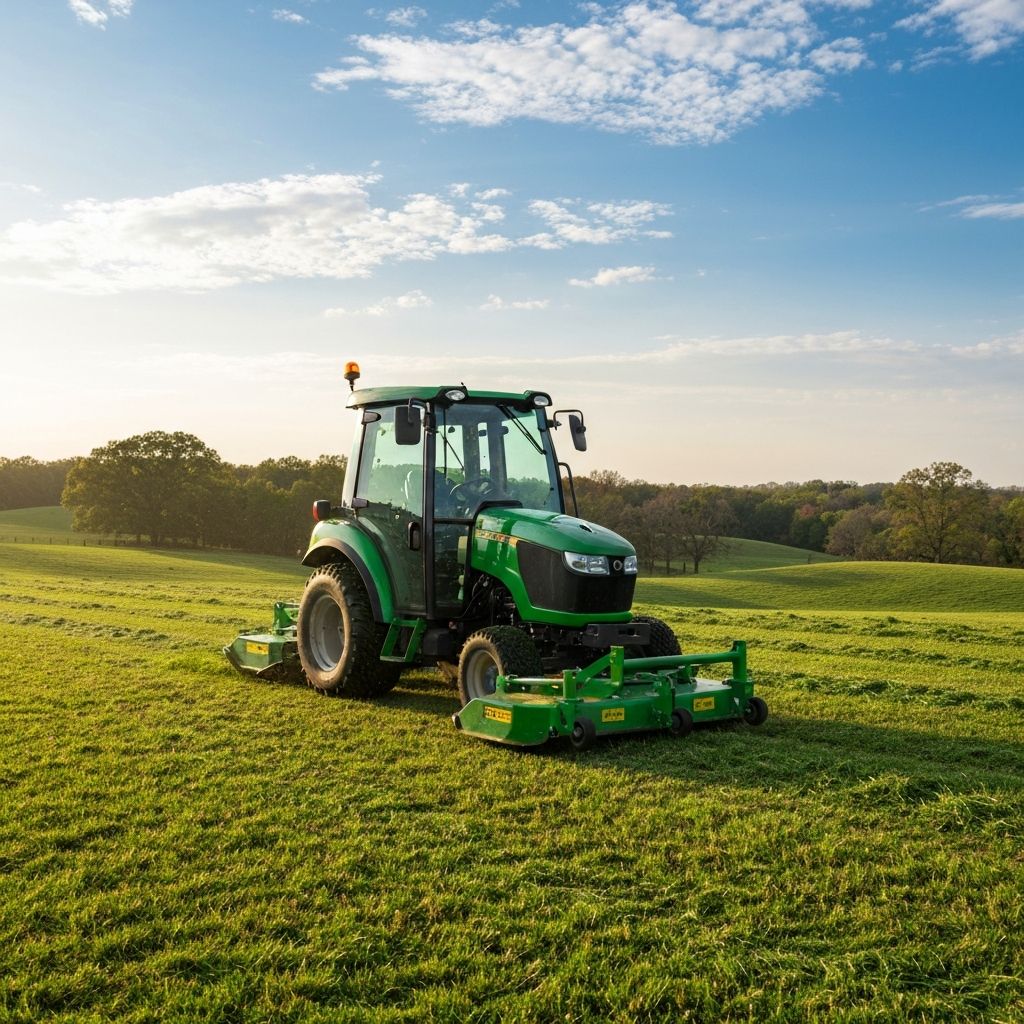
Best Tractors for Mowing (2026)
Updated Feb 5, 2026
Expert guide comparing 20+ tractors for lawn, pasture, and rough cut mowing. Coverage of PTO horsepower, deck width recommendations, terrain requirements, and top picks for finish mowing through heavy brush hogging.
What Makes a Good Mowing Tractor
Mowing is the most common tractor task for property owners. Whether you're maintaining a manicured lawn, keeping pastures trimmed, or clearing brush, matching your tractor to your mowing needs ensures efficiency, quality results, and operator comfort.
PTO HP vs Engine HP
PTO (power take-off) horsepower is what actually powers your mower. Engine HP is always higher—typically 15-20% is lost through the drivetrain. Always check PTO HP when sizing a mowing tractor. A 25 HP engine might only deliver 19-20 PTO HP.
Deck Width Matching
Match deck width to acreage and tractor size. Sub-compacts typically run 54-60 inch decks; compact tractors handle 60-72 inches. Wider isn't always better—ensure your tractor has adequate PTO HP (roughly 1 HP per 3-4 inches of deck width for finish mowing).
Mid-Mount vs Rear Mowers
Mid-mount mowers sit between the axles, providing excellent visibility and maneuverability for finish mowing around obstacles. Rear-mount finish mowers and rotary cutters are wider and better for open areas but can't trim as close to fences and trees.
Hydrostatic for Mowing
Hydrostatic transmission is strongly preferred for mowing. It provides infinite speed control without clutching, smooth direction changes, and consistent ground speed—all essential for quality cut and operator comfort during hours of mowing.
Turn Radius Matters
Tighter turn radius means less uncut grass on turn-arounds and easier mowing around obstacles. Sub-compact tractors typically turn in 7-8 feet; compact tractors need 8-10 feet. Consider your property's layout when evaluating maneuverability.
Weight and Stability
Heavier tractors are more stable on slopes and provide better traction through thick vegetation. For hilly terrain, prioritize weight and 4WD over pure horsepower. A stable tractor is a safe tractor, especially on properties with varying terrain.
Start With Your PTO Requirement
Different mowing implements require different amounts of PTO horsepower. A finish mower for lawns needs far less power than a heavy-duty brush hog clearing saplings. Match your PTO to your most demanding mowing task.
| Mower Type | Minimum PTO HP | Recommended PTO HP | Notes |
|---|---|---|---|
| 54" Mid-Mount Deck | 15-18 HP | 18-22 HP | Standard for sub-compact tractors, residential mowing |
| 60" Mid-Mount Deck | 18-22 HP | 22-28 HP | Popular size for 2-5 acre properties |
| 72" Mid-Mount Deck | 25-30 HP | 30-40 HP | Large lawns, requires compact tractor |
| 5 ft Rear Finish Mower | 20-25 HP | 25-35 HP | Open areas, parks, maintained fields |
| 5 ft Rotary Cutter (light) | 25-30 HP | 30-40 HP | Grass and weeds, maintained pasture |
| 6 ft Rotary Cutter (medium) | 35-40 HP | 40-50 HP | Mixed vegetation, moderate brush |
| 6 ft Rotary Cutter (heavy) | 45-50 HP | 50-65 HP | Brush, saplings up to 2-3 inch diameter |
| 7 ft Rotary Cutter | 50-60 HP | 60-75+ HP | Large pastures, commercial clearing |
Mowing Tractor Recommendation Calculator
Answer a few questions about your mowing needs and get personalized tractor recommendations with calculated PTO requirements, deck size suggestions, and top 3 best-fit models.
Your Requirements
Your Results
Fill in your requirements and click "Calculate" to see personalized recommendations.
Mowing Tractor Comparison Table
Compare 20 mowing-capable tractors side by side. Click column headers to sort.
| Model | Engine HP | PTO HP | Weight | Mid-Mount Deck | Turn Radius | Trans. | Class | Best For |
|---|---|---|---|---|---|---|---|---|
| Kubota BX2380 | 21.6 | 16.6 | 1,477 | 54-60 in | 7.2 ft | Hydrostatic | Sub-Compact | Residential lawns, small acreage |
| John Deere 1025R | 23.9 | 18.2 | 1,516 | 54-60 in | 7.5 ft | Hydrostatic | Sub-Compact | Estate mowing, light property work |
| Yanmar SA424 | 24 | 19 | 2,312 | 60-72 in | 7.9 ft | Hydrostatic | Compact | Precision finish mowing |
| John Deere 3025E | 24.7 | 19.2 | 2,425 | 60-72 in | 8.0 ft | Hydrostatic | Compact | Mixed property maintenance |
| Kubota L2501 | 24.8 | 19.5 | 2,535 | 60-72 in | 8.2 ft | Hydrostatic | Compact | 5-15 acre properties, finish mowing |
| New Holland Workmaster 25 | 24.7 | 19.8 | 2,380 | 60-72 in | 8.1 ft | Hydrostatic | Compact | Reliable finish mowing |
| Mahindra 1626 | 26.2 | 20.5 | 2,756 | 60-72 in | 8.5 ft | Hydrostatic | Compact | Budget finish mowing |
| LS MT235E | 34.8 | 28.2 | 2,890 | 72 in | 8.7 ft | Hydrostatic | Compact | Value compact mowing |
| Kioti CK3510SE | 35 | 28.5 | 3,064 | 72 in | 8.9 ft | Hydrostatic | Compact | Mixed mowing duties |
| John Deere 3038E | 37.3 | 30.1 | 3,086 | 72 in | 8.8 ft | Hydrostatic | Compact | Large lawns, light brush hogging |
| Mahindra 2638 | 37.4 | 30.5 | 3,450 | 72 in | 9.2 ft | Hydrostatic | Compact | Value brush hogging |
| Kubota L3901 | 37.5 | 30.8 | 3,197 | 72 in | 9.0 ft | Hydrostatic | Compact | Large property maintenance |
| John Deere 4044M | 43.1 | 35.8 | 4,012 | 72 in | 9.3 ft | Hydrostatic | Compact | Premium large property mowing |
| Kubota L4701 | 47.3 | 39.2 | 3,902 | 72 in | 9.5 ft | Hydrostatic | Compact | Heavy brush and pasture |
| John Deere 5055E | 55 | 45.7 | 4,630 | N/A | 10.8 ft | Gear/Hydro | Utility | Commercial brush hogging |
| Case IH Farmall 55C | 55 | 45.8 | 4,523 | N/A | 10.5 ft | Gear/Hydro | Utility | Versatile pasture mowing |
| Kubota MX5400 | 55.5 | 46.3 | 4,409 | N/A | 10.2 ft | Hydrostatic | Utility | Heavy rotary cutter work |
| Kubota M6060 | 64 | 53.5 | 5,512 | N/A | 11.2 ft | Gear/Hydro | Utility | Large pasture maintenance |
| Mahindra 6065 | 65 | 54.2 | 5,291 | N/A | 11.5 ft | Gear/Hydro | Utility | Heavy-duty brush clearing |
| New Holland T4.75 | 75 | 63.1 | 5,890 | N/A | 12.0 ft | Gear/Hydro | Utility | Wide rotary cutter operations |
Picks by Use Case
Best for Finish Mowing Lawns (Under 25 PTO HP)
Sub-compact and light compact tractors ideal for manicured lawns, estate properties, and small acreage.
Kubota BX2380
John Deere 1025R
Kubota L2501
New Holland Workmaster 25
Best Compact Tractors for Mowing (25-40 PTO HP)
Versatile compact tractors for 5-20 acre properties, pasture maintenance, and light brush work.
John Deere 3038E
Best Tractors for Brush Hogging (40+ PTO HP)
Utility tractors with adequate power for 6+ ft rotary cutters and heavy brush clearing.
Best Budget Mowing Tractors
Value-focused brands offering good mowing capability at competitive prices.
Best Premium Mowing Tractors
Top-tier machines from established brands with excellent dealer support and resale value.
John Deere 1025R
John Deere 3038E
Mowing Safety, Speed, and Technique
Slope Safety Guidelines
- Never mow slopes greater than 15 degrees—tractors can roll
- Mow across slopes, not up and down, to maintain stability
- Use 4WD on any slope to maintain traction and steering control
- If wheels start slipping, stop immediately—do not accelerate
Optimal Mowing Speeds
- Finish mowing: 4-6 mph for quality cut without skipping
- Pasture maintenance: 3-5 mph for consistent results
- Brush hogging: 1-3 mph through thick vegetation
- Trim work: 2-3 mph around obstacles for precision
Blade Maintenance Schedule
- Finish mower blades: Sharpen every 20-25 hours—dull blades tear grass
- Rotary cutter blades: Inspect every 50 hours—designed for impact
- Always balance blades after sharpening to prevent vibration
Pre-Mow Checklist
- Walk the area and remove rocks, wire, and debris
- Check blade condition and belt tension
- Verify cutting height is set correctly for conditions
- Check PTO engagement and deck level
Brush Hog Safety Warning
Rotary cutters can throw debris at high velocity. Always maintain 300+ feet clearance from people, vehicles, and buildings. Never allow riders on the tractor during brush hogging. Stop the PTO before dismounting.
Choosing the Right Mower Type
Mid-Mount Mower Deck
Mounts beneath the tractor between axles. Excellent visibility, tight maneuvering, and clean cut quality. Standard 54-72 inch widths. Best for lawns and manicured properties.
Best for: Residential lawns, estatesRear Finish Mower
3-point hitch mounted, typically 5-7 ft wide. Good cut quality but less visibility than mid-mount. Better for open areas like parks and sports fields where maneuvering is less critical.
Best for: Parks, open fieldsRotary Cutter / Brush Hog
Heavy-duty 3-point implement for rough cutting pastures, fields, and brush. Not for finish quality—designed for durability and power. Handles thick weeds, tall grass, and small saplings.
Best for: Pastures, brush clearingFlail Mower
Uses swinging flails instead of fixed blades. Better mulching, handles debris better than rotary cutters, and safer (less projectile risk). More expensive but excellent for orchards and vineyards.
Best for: Orchards, vineyards, debris areasSickle Bar Mower
Reciprocating blade system that cuts like scissors. Low power requirement, clean cut for hay production. Not for rough terrain or thick brush—delicate but efficient for hay fields.
Best for: Hay cutting, wildflower meadowsCombination Approach
Many property owners use multiple mowers: a mid-mount deck for the lawn and a rotary cutter for pastures. Quick-detach loaders make swapping between tasks efficient.
Best for: Mixed-use propertiesFrequently Asked Questions
How much PTO HP do I need for a brush hog?
For a 4-5 ft brush hog cutting grass and light weeds, 20-25 PTO HP is sufficient. For 5-6 ft cutters handling thicker vegetation, plan for 30-40 PTO HP. Heavy-duty 6-7 ft brush hogs cutting saplings and dense brush require 45-60+ PTO HP. Always check the manufacturer's minimum PTO HP requirement for your specific cutter—undersizing leads to stalling and premature wear.
Is hydrostatic or gear transmission better for mowing?
Hydrostatic is strongly preferred for mowing. It allows infinite speed control, seamless direction changes, and consistent ground speed without clutching. This is especially important when mowing around obstacles, on slopes, or maintaining uniform cut quality. Gear transmissions work but require more operator effort and make maintaining consistent speed difficult on variable terrain.
How wide of a mower should I run?
Match deck width to property size and tractor capability. For 1-3 acres, 54-60 inches is efficient. For 5-10 acres, 60-72 inches reduces mowing time significantly. Over 10 acres, consider 72-inch mid-mounts or 5-7 ft rear rotary cutters. Wider isn't always better—narrow gates, tight spaces, and slopes may require smaller decks. Also ensure your tractor has adequate PTO HP for the deck size.
Do I need 4WD for mowing hills?
4WD isn't strictly required for mowing but provides significant safety advantages on slopes. 4WD maintains traction when turning on wet grass, prevents sliding on moderate grades, and provides better control when mowing across hillsides. For flat terrain, 2WD works fine, but 4WD is recommended for any property with slopes greater than 10-15 degrees.
What's the difference between mid-mount and rear finish mowers?
Mid-mount mowers sit beneath the tractor between the axles, providing excellent visibility to the cut area and tight trimming capability. They're ideal for finish mowing lawns. Rear-mount finish mowers attach to the 3-point hitch and are wider (typically 5-7 ft), better for open areas but have reduced visibility and can't trim as close to obstacles.
Can a sub-compact tractor run a brush hog?
Yes, but with limitations. Sub-compact tractors (20-25 HP) can run 4-5 ft brush hogs through grass and light weeds. However, they lack the weight and PTO power for heavy brush, saplings, or thick vegetation. For anything beyond maintained pasture, a compact or utility tractor is recommended. Also, brush hogs on sub-compacts work the tractor hard—expect slower speeds and more wear.
How fast should I mow with a tractor?
Optimal mowing speed depends on conditions. For finish mowing lawns with a mid-mount deck, 4-6 mph produces a quality cut. For rough cutting pastures with a rotary cutter, 3-5 mph is typical. Brush hogging heavy vegetation may require 1-3 mph. Going too fast leaves uncut strips and stresses the mower. Going too slow reduces productivity and can create scalping.
What's the minimum PTO HP for a 6 ft rotary cutter?
A 6 ft rotary cutter typically requires 35-50 PTO HP minimum, depending on the cutter's duty rating and vegetation. Light-duty 6 ft cutters for maintained pasture need 35 PTO HP. Medium-duty cutters for mixed grass and weeds need 40-45 PTO HP. Heavy-duty cutters for brush and saplings need 50+ PTO HP. Always check the specific cutter's manual for requirements.
Should I get a belly mower or pull-behind mower?
Belly mowers (mid-mount) are best for finish mowing where cut quality matters—lawns, parks, sports fields. They provide excellent visibility and can trim close to obstacles. Pull-behind/3-point mowers are better for rough cutting large areas where speed matters more than appearance. For properties needing both, a mid-mount for the lawn and a rotary cutter for pastures is common.
How often should I sharpen mower blades?
For mid-mount finish mowers, sharpen blades every 20-25 hours of use or when cut quality degrades (torn grass tips, uneven cut). For rotary cutters, inspect blades every 50 hours—they're designed to impact and can tolerate more wear, but damaged blades reduce efficiency. Always balance blades after sharpening. Keep spare blades on hand to minimize downtime.
Related Guides
Front-end loader lift capacity and ballast tips
Tractor Attachment GuideMower decks, rotary cutters, and more
Best Tractors for 5 AcresSmall property tractor recommendations
Browse Compact TractorsCompare all compact models with mowing capability
Find Dealers Near YouLocate authorized dealers in your area
All Task-Based GuidesLoader work, hay, grading, and more
This guide is maintained by the Tractor Iron editorial team using manufacturer specifications, dealer input, and real-world owner feedback. Specifications are verified against official sources and updated regularly. Last updated: February 5, 2026.